Skip to content

Guest Post by Jacqueline about the availability, or not, of T3-only meds
The following is written by thyroid patient Jacqueline of the United States, and may be of interest to all of you who use T3 / T3-only, no matter where you live. Her mention of Cytomel is a major brand of T3, but there are other versions.

Let Jacqueline and others hear about your issues with finding T3.

Just spent the better part of two hours trying to locate some Cytomel after Walgreens and Safeway said they and all their distributors (which are used by all the other pharmacies) are out of the 25 mcg size tablets. I have tried to locate Cytomel at least two times in the last 6 months. Earlier, I had been able to locate some in the pipeline of pharmacies and distributors. But not anymore.

Keep in mind that I do not convert T4 to T3 very much ( I do take NP Thyroid for T4, T3, T2, T1). I have tried generic and compounded T3 meds and got nothing from them. So I switched back to Pfizer-branded Cytomel last year with now a HUGE expense as the price is now so high that the formularies do not list it any more, meaning I only get 20% coverage.

Per day, I take two of the 25 mcg of Cytomel by Pfizer, plus 60 mcg (~1 grain) NP Thyroid. I have taken Cytomel for 20 years. To try to save money after Pfizer hiked the price about six (?) years ago, I tried switching to the generics and to compounded T3. But they were very ineffective for me, and I have been dealing with health problems that the attempted switch caused for the last year and a half. I resigned myself to the high expense, but now Pfizer has disrupted the supply, and may now be making changes in how/where it is made. UGH

My experience in trying to reach Pfizer

1. When I tried to send an email to Pfizer via their website, the field keeps saying I have too many characters no matter how many are in the box, so that was a failure.
2. When I called Pfizer Customer Service 800-533-4535 five times today this happened: there is only voice option to respond to questions on the menu, so I said “Product Information”, then “Cytomel”. They cut me off every time. No idea if the call system is broken or the product name triggers the line to be cut.
3. When I called 800-438-1985, I took the section for “Professionals” because that was the only thing that made sense. A service rep took down all my personal information, then found me a customer rep.

What Pfizer’s customer rep stated to me i.e. these “company-lines”:

a. 50 mcg is not being made until March 2019, and is unavailable. (I could use this size of the pills by cutting them in half, would save me the most money, actually.)

b. 25 mcg is not being made until March 2019, and can be ordered by pharmacy drop ship to individual patients. Actually, the manager Safeway’s pharmacy refused to do this for me. My Walgreens pharmacy did it, by going though their distributor, which the customers service rep did not understand would be necessary. Pfizer gives only two bottles per call to the pharmacist, and I got one, another client got the other. I have no idea how long this will take – last time Walgreens ordered a drop ship of Cytomel, it took 3 weeks, acc’g to the gal at Walgreens. This will not last me until end of March, so I have to consider other options, as well. Meanwhile, the old Cytomel pills expire in February!! I have no problem taking them for a while post expiration, but this is all a mess.

c. 5 mcg are back on the shelves. I would have to take 10 pills a day plus maybe 1 or 2 more to compensate for the extra filler in so many pills- thus could cost me, after the piddling 20% insurance coverage, $800 or more per month. This is the most expensive option, but I may need a back-up.

Why the disruption in supply?

Pfizer Customer Rep said that there is some “change in ingredient(s) supplier.” The exact details are considered private “corporate information” LOL. Actually this is CRUCIAL info for docs and their patients. I will consider moving to a different company’s product since there are going to be changes and the timing is not certain or shared with patients.

i. If even one ingredient is being made in a new facility, the formula is different, and may not perform the same. For those of us who depend on something in its exact form, WE NEED TO KNOW THIS.

ii. Since we depend on this product for our health, we need to know the TIMING of this, and whether they DEFINITELY will resume producing this medication.

iii. Reasons for disruption are factors we and docs should know for deciding whether to change to a different version.

My theories about why this happened

1. Price hikes led to removal from formularies (official list giving details of prescribed medicines) led to limited insurance coverage, rather than co-pays, which then reduced demand (I tried to switch away for this very reason, but nothing worked, so I came back despite the insane expense). For example, the first approx. 14 years of taking Cytomel, it was covered by my co-pay. Then the list price went way up A LOT (why? KEY INFORMATION NEEDED BY US as patients who NEED T3). From that point on my insurance only gave me back 20%, so I was paying almost $500/month. When I gave upon on alternatives and went back to Cytomel, I was on T3-only to reduce RT3, so I was actually able to take fewer pills (2 x 25mcg vs. 4x 5mcg in the past), which reduced the cost a bit as it seems to be more based on # pills than #mcg. It is likely that many switched to generics or compounded versions to save money when the price was hiked. The reduced demand would make it less profitable, and harder on the production facility.

2. Cost of raw materials went up? Raw materials in short supply??? How they are looking for alternatives?? If this is the case, the company should be telling us this!!

3. Raw materials supposedly made in Puerto Rico facilities taken out by Hurricane Maria and now unavailable??? If so, Pfizer should be telling us this.

4. 5 mcg are likely the most popular as they are most common usage is to supplement a T4-only synthetic or a Natural Desiccated Thyroid (NDT)) with a little bit of T3. For example. I used to take 150 mg Tirosint (gel-based T4, also very expensive now, so I switched) plus 20 mcg Cytomel. However, when my RT3 went way up (after I was on generic and compounded T3!), I had to take A LARGE amount of Cytomel for T3-only therapy: my theory is that the numbers of people taking such high doses of T3 and/or doing (temporary) T3-only therapy are not that high or constant, so there is is not much demand for the 25 mcg or 50 mcg pills of Cytomel.

Sorry about this long saga, but I hope to help others.

If anyone has any further info about any of this,. or any suggestions, or any relevant experiences, I am very interested.
Please post!!! ~Jacqueline

******************

From Janie: as we wait for more information as well as your comments on this important Guest Blog post, here are links to help you in your quest to feel better..

1) Want to order your OWN labwork because you like being self-directed? Go to this page and scroll down to see the icons for different lab facilities.

2) Have a high RT3? Check out this page.

3) Learn what patients have learned in the use of T3-only.

4) See the different brands of T3 in pink on the Armour vs Other Brands page.

5) Have what looks like a optimal free T3 (top part of range or even higher) but you still feel awful? You may be pooling due to a cortisol issue that needs discovery with a saliva test. Once you get your saliva results back, DO NOT go by their graph. Go by this page.

6) Here’s info on the different thyroid medications: https://stopthethyroidmadness.com/hypothyroid-medications/

NOTE: if you are reading is via the email notification you signed up for, DO NOT REPLY TO THE EMAIL. It will not be received. If you want to comment, CLICK ON THE TITLE of this blog post, then scroll down to comments.

Stupidity Award of the Year: the UK’s NHS states that T3 has “little or no clinical value”

The following Guest Blog post has been written by UK Thyroid Patient Carolyn and contributions added by Janie A. Bowthorpe

*********************

Just when you think things couldn’t get more ridiculous….

Just a few days ago, the BBC reported that the National Health Service (NHS) of the United Kingdom has proposed that the medication T3-only, aka Liothyronine, has little or no value. Let me repeat: LITTLE OR NO VALUE.

The article also states: “The proposals could see an outright ban or tighter restrictions on some products being prescribed by GPs.”

Here’s the list, as reported by the BBC, of those they consider as low value medicines (and their annual cost to the NHS):]

  • £30.93m on Liothyronine to treat underactive thyroid
  • £21.88m on gluten-free foods
  • £17.58m on Lidocaine plasters for treating nerve-related pain
  • £10.51m on Tadalafil, an alternative to Viagra
  • £10.13m on Fentanyl, a drug to treat pain in terminally ill patients
  • £8.32m on the painkiller Co-proxamol
  • £9.47m on travel vaccines
  • £7.12m on Doxazosin MR, a drug for high blood pressure
  • £6.43m on rubs and ointments
  • £5.65m on omega 3 and fish oils

Also mentioned in the article after the above “low value” medications comes “suncream, cough and cold remedies and indigestion and heartburn medicines”. i.e. T3-only, which patients report has brought back MUCH better health, is on the same level as suncream.

The article states that the “NHS England confirmed the review would begin in April, but did not put any timescale on how quickly a decision would be made.

Living in the UK as a hypothyroid patient

Those like me living in the UK and using the NHS (which by the way is not ‘free’, as we all pay into it through our taxes), appreciate that it isn’t a bottomless pit of money which can fulfill every single person’s desires. Some of the items on this list (see above) are easily and cheaply available over the counter in pharmacies and supermarkets. I believe people also have a responsibility to purchase some things themselves rather than incurring the excessive cost of processing an unnecessary doctor’s prescription.

But T3 isn’t available over the counter, although it is in some other European countries.

The sole reason T3 is on this list at all is the cost. Just look at that amount of money: £30.93million annually— that’s a lot of money, and who wouldn’t want to save that.

But despite this drug called Liothyronine (aka T3) costing pennies to make, and costing a couple of Euros on the mainland, it costs over £9 A TABLET to the NHS. No wonder they don’t want to prescribe it.

A loophole in legislation around generic medicines has been massively exploited and the cost has been steadily increased by the sole licensed supplier. So rather than investigate that situation of being totally ripped off and putting a proper system of value-for-money purchasing in place, the answer that is being proposed is to withdraw T3. What a failure of proper management of resources; I expect better of my government officials.

I have friends with the genetic mutation which means they literally cannot convert T4 to T3, even before we get into the debate about T4-only thyroid hormone replacement detailed below. They are being condemned to a long slow death.

A health care system which is held up as a model for the rest of the world is going backwards.

We aren’t all able to change doctors and a private prescription would be prohibitively expensive for most people, even if the doctors working in the private sector would be prepared to step outside the cruel guidelines still in place for treatment of hypothyroidism in the UK.

I can only hope that someone listens to the cries of outrage following this proposal and takes some sensible action to correct this massive pricing discrepancy. Getting proper treatment with T3 or NDT shouldn’t be this difficult and is a false economy.

Before I was refused any treatment due to the guidelines, I was off work ill for months. I was working full time within weeks of starting Natural Desiccated Thyroid; back paying my tax and supporting the NHS.

Let’s talk a minute about T3

For those who might be new to this, a healthy thyroid produces five known hormones: T4, T3, T2, T1 and calcitonin. Those five hormones are a wonderful symphony of what makes a healthy thyroid function. (Chapter 2 in the revised STTM book gives excellent detail about all this)

And hypothyroid patients were treated with all five hormones from the 1800s onward via pig or sheep thyroids…until the early 1960’s when Knoll Pharmaceuticals decided to promote its “new and modern” treatment for hypothyroidism–T4-only. i.e. no direct T3. T4 is a storage hormone meant to convert to the powerful and health-giving T3. And everyone fell for this promoted fallacy that somehow, giving patients only one of five thyroid hormones was a hunky-dory way to treat hypothyroidism. (See Chapter 1 in the Revised STTM book! Learn the truth!!)

But they were dead wrong. T4-only, aka Synthroid, Levoxyl, Levothyroxine, Unithroid, Eltroxin, Levaxin, Norton, Eutrosig, Oroxine, or Tirosint, seems to have failed millions of patients in their own degree and kind, over the years, forcing all who are prescribed it to live for “conversion” alone. Yes, some do better than others! But the large amount of people who have NOT done well is profound….just as it’s profound how many T4-users report feeling far better when they added direct T3 in their treatment, or Natural Desiccated Thyroid.

My final message to the NHS

You are seriously wrong to state that the medication Liothyronine (aka T3) has little or no value as a way to cut costs.

Your conclusion means that you will end up subjecting your fellow UK residents to a lifetime of continued hypothyroidism thanks to being forced to live for conversion alone on levothyroxine as a sole treatment for hypothyroidism (See seven studies/articles at the bottom of this blog post). Your conclusion also seriously harms those who have the DIO1 or DIO2 mutation, which prevents these individuals from converting T4 to T3 adequately.

Get with it, NHS. Wise up. Stop this massive ongoing cruelty to thyroid patients.

UK THYROID PATIENTS: Share this blog post anywhere, everywhere. Let’s send a firm message to the NHS. Copy and paste:

https://stopthethyroidmadness.com/2017/04/02/stupidity-award-nhs/

*****************************

RESEARCH SHOWING THAT T3 COMBINED WITH T4 GIVES BETTER RESULTS (from https://stopthethyroidmadness.com/medical-research):

  1. Here’s a study from 1996 which underscored that both T4 and T3 are needed to remove hypothyroidism: http://www.ncbi.nlm.nih.gov/pubmed/8641203 (And it followed research from the previous year showing that T4-only did NOT do the job—see http://www.ncbi.nlm.nih.gov/pmc/articles/PMC185993/)
  2. As far back as 1999, the New Journal of Medicine reported superior results of a synthetic T4 and T3 combination treatment, especially on the brain and other tissues. http://content.nejm.org/cgi/content/full/340/6/424
  3. And another one titled Thyroid Insuffiency: Is Thyroxine the Only Valuable Drug, http://www.encognitive.com/ Journal of Nutritional & Environmental Medicine (2001), 11, 159—166
  4. And here’s another one from 2009: http://www.eje-online.org/cgi/content/abstract/EJE-09-0542v1 (has a fee) but here’s where you can at least see the abstract: http://www.ncbi.nlm.nih.gov/pubmed/19666698 They evaluated depression and anxiety rating scales as well as patients own preference.
  5. Also this one: http://www.endocrine-abstracts.org/ea/0013/ea0013P316.htm
  6. At first blush, this Amsterdam study appears to give the same propaganda of T4 only. But as you read on, it mentions this: Third, recent animal experiments indicate that only the combination of T4 and T3 replacement, and not T4 alone, ensures euthyroidism in all tissues of thyroidectomized rats. From 2001, Developmental Endocrinology to Clinical Research: http://content.karger.com/ProdukteDB/produkte.asp?Aktion=ShowAbstract&ArtikelNr=48140&Ausgabe=227546&ProduktNr=224036
  7. John C. Lowe’s Four 2003 Studies of Thyroid Hormone Replacement Therapies: Logical Analysis and Ethical Implications Excellent article (16 pages) about the efficacy of using T4 and T3 in treatment, and not using the TSH, and so much more.


About Quinoa; Mistakes made on T3-only; Thyroid Patients and West Nile Virus

“WHAT IS THAT??”

As a thyroid patient who went to hell and back thanks to 20 years of a lousy treatment by allopathic medicine, I care about my good health and what I eat. So I attempt to balance my eating sins. And when I was recently at a salad bar, I couldn’t figure out what a particular bowl of food was, sitting next to mixtures of fruit, pastas, etc.

It looked like “frog eye salad”, which is made up of teeny tiny b-b size pasta and sweet fruits. But this had tomatoes in it. And the small round things had a thin white line around them. Were they fish eggs??

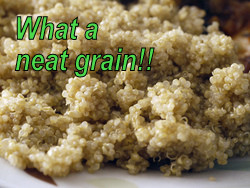
Turns out its a high protein, higher fiber whole grain called Quinoa (pronounced keen-wa), and is loaded with nutrients, including the minerals iron, zinc, and selenium, plus vitamin E and lysine, and all essential amino acids. I got a scoop and I was impressed.

And voila….if you need to be gluten-free, this grain gets the mark! I plan on buying some at my local health food store for an occasional hot breakfast cereal (as I suspect my husband would do better avoiding gluten thanks to frequent digestive issues), besides strongly recommend it to my husband’s niece, who badly needs to go gluten-free to lower her high inflammation levels.

Don’t feel the need to avoid gluten?? This still looks like a great grain and food to become familiar with, which I’m going to do! But a word of warning: it’s not low carb. So like any carb you intake, you’ll want to eat it in moderation.

KEY MISTAKES IF YOU ARE ON T3-ONLY, says a lot of patient experience

Though ten years of strong patient experiences show that natural desiccated thyroid gives the best results for thyroid disease, some thyroid patients have to be, or choose to be, on T3-only. It’s definitely a far better treatment than the lousy T4-only treatment with Synthroid and other brands.

And along the way, we’ve figured out some mistakes we may be making when using T3-only:

  1. Dosing rigidly every certain amount of hours When patients were first learning about using T3-only (which requires more multi-dosing at first than does natural desiccated thyroid), we thought it was a good idea to dose rigidly about every 4-5 hours or so, thinking that T3 would peak about 4 hours after taking the first dose, then make a fall, and you’d then need to replenish your levels. We were wrong with that rigidity.It can be very individual when one needs a dose of T3. Some might need another dose of T3 in three hours after taking the first one due to a higher metabolism. So if they go longer, they put themselves in an increasing hypothyroid state. Another person might be a slow metabolizer and only need their next dose in 5 or 6 hours. So if you take it too soon, you put yourself in the direction of a hyper state.Turns out you need to be dosing T3 when your body tells you it’s time you need it! How to know? Your signs and symptoms. Look for clues that you need your next dose, like a rising heartrate or blood pressure, depression, fatigue, or any hypothyroid symptom unique to you. Notate that on paper, then you’ll know to take your T3 right before that time the next day. It might take a few days of experimenting to figure out when your ideal dosing times are.
  2. Multi-dosing T3 too many times during the day As patients, we used to think that we need to dose T3 up to four to fives times a day in smaller doses. But with our new knowledge about T3, several patients have noted noted that moving dosing to 2-3 times a day, and thus in larger amounts each time, has resulted in better treatment of their hypothyroid state, especially with better cortisol levels.
  3. Thinking that different brands of T3 are equal Unfortunately, some brands of T3 are weaker than others. And occasionally, some batches of a better brand may be bad due to heat exposure. Generally, patients have reported Cytomel to be of a quality and consistent strength. Cynomel has been reported as equal in strength, but lately, patients have found some batches to be weak and are reporting this to the company. UK’s Liothyronine by Goldshield has been reported by patients as weaker in strength all the time. All in all, Cytomel has received the most positive scores.

Using T3 all day while doing the T3 Circadian Method (T3CM) for your proven adrenal fatigue?? As your adrenals kick back in, you may notice that you 1) need to space your T3 farther apart, and 2) that you will need less T3.

WEST NILE VIRUS IS BACK LIKE A VENGEANCE: WHAT YOU AS A THYROID PATIENT SHOULD BE DOING!

Found out that a cousin of mine, who’s a father of two young children, found himself with West Nile Virus several days ago. I got West Nile about 5 years ago, as well. For many of us, it’s like the WORST flu you ever had, and you can take a few weeks to get over your post-illness weakness.

And since having a compromised immune system (as struggling hypothyroid/adrenal patients can have) makes one more vulnerable to the virus effects, I can see it being imperative to be on immune-supportive herbs right now, besides putting on some kind of mosquito repellant of your choice. I also read about Lomatium root, which is supposedly very anti-viral. I would talk to your local health food/supplement store for recommendations.

Who has the vision and courage of Dr. Lowe…and a message from Acella about delays

Each day, when I think about the passing of Dr. Lowe (which you can read about here), I reel in shock at this huge loss in our fight for better thyroid treatment and SANITY.

And now we have to ask: who will fill those shoes when it comes to the continuation of thyroidscience.org and the courageous message of Dr. Lowe?? Even the front page contains an important article titled “TSH is Not the Answer,” a report Dr. Carol Rowsemitt and Dr. Thomas Najarian: Their explanation and verification i.e. Dr. Lowe fought for what PATIENTS ALREADY KNOW TO BE TRUE about the lousy TSH lab test!

And Lowe announced that he was next coming out with an article concerning ” false statements of fact online about T3-containing thyroid products including Armour Thyroid” by The British Thyroid Association and UK Royal College of Physicians. He continued: ” The scientific facts patently show the falsehood of the two organizations’ statements. Is this a failure of responsibility to study scientific issues before making public pronouncements on them? Or do the statements constitute science fraud?” Unless it was already written, we might never see this article. But we all know the truth.

The loss of Dr. Lowe propels me to ask: Who do YOU see as a medical professional who has the following qualities:

  • high intelligence
  • an interest in true science rather than blindly following research with outcomes based on who paid for certain studies
  • the courage to speak the truth, even if it goes against the grain of staid medical opinion
  • compassion for thyroid patients and the willingness to listen to their experiences

Who, as a medical professional, can patients give a vote of confidence to as someone who can continue the legacy of Dr. Lowe? Propose some names by commenting on this blog post below. (If you are reading this via the Email Notification, click on the title of this post, which will bring you directly to the blog post where you can leave a comment).

A MESSAGE FROM ELLEN GETTENBERG of ACELLA (THE MAKERS OF GENERIC DESICCATED THYROID CALLED N.P. THYROID)

Over the past several weeks, Acella has experienced production planning issues associated with NP Thyroid. We sincerely apologize for this and want to inform our valued customers that we are putting measures in place now to prevent any further limited supply. We anticipate improved availability by the end of January. Please check back here on our website for further updates. If you need additional information, please email us through the “Contact Us” page on NPThyroid.com.

Ellen Gettenberg
Director, Marketing| Acella Pharmaceuticals
9005 Westside Parkway | Alpharetta, GA 30009
www.acellapharma.com

WANT TO PAY IT FORWARD AS TO WHAT STTM HAS GIVEN YOU?

Out of my own savings last Fall, I paid for three months in hiring a publicist for the message of Stop the Thyroid Madness…i.e. through the end of December. My goal is to reach far more who may not understand WHY they have problems thanks to the lousy TSH lab test or T4-only meds like Synthroid, Levothyroxine, etc. And she has done a fabulous job in getting interviews and articles out there–you can see what she has done on the donation page mentioned below.

After December, patients donations completely paid for January. Now we are working on February, and nearly half way there. But this will end sooner than later if more donations don’t come in. Go here to read about it and Pay It Forward.

HAVE YOU CONSIDERED YOU MAY NOT NEED HC TO HEAL YOUR ADRENALS? OR IF ON HC, YOU CAN DO THIS A LOT FASTER?

UK thyroid and adrenal patient Paul Robinson made a VERY interesting discovery–that he could heal his adrenals with his unique use of T3. Yup, and he SUCCEEDED. And it’s quite exciting news for adrenal fatigue patients. Additionally, if you are on T3, his T3 titration process alone is vastly superior to most other recommendations in the use of T3, and means you can use less!!

Take the time to find out for yourself!! There’s a good summary of what he discovered in the new STTM Facebook Adrenals group (and please note this group is for PATIENTS ONLY, not medical professionals. And for approval to the group, you canNOT have a hidden info and friends. We have to be this way to keep out spammers, and to see that you are who you say you are). You can also order his book from this Recommended books page on STTM. To order the patient-to-patient STTM book, go here.


T3 to heal adrenals, Selenium, liver–all important info for thyroid patients!

Though this post was written in 2012, it has been updated to the current day and time and it still applicable. Enjoy!

HOW T3, DOSED A CERTAIN WAY, CAN REVERSE YOUR ADRENAL FATIGUE, says Paul Robinson!

UK’s Hashimoto’s patient Paul Robinson has been a successful T3-only treated patient for more than 13 years, especially because he never did well on either synthetic T4, nor on the combination of T4/T3. And he learned so much about himself that he compiled all the information on T3 dosing in his book called Recovering With T3: My Journey from Hypothyroidism to Good Health Using the T3 Thyroid Hormone.

But what I especially find interesting is how he used T3 to cure his flagging adrenal function rather than HC (hydrocortisone). And here is a short summary of key points. He calls this The Circadian T3 Method, aka the CT3M.

  1. Most of the day’s cortisol is made in the last four hours of sleep, which means your adrenals work their hardest during that time. And like any cell in your body which need T3 to function well, so do your adrenal cells…especially during the time they work the hardest.
  2. With the above in mind, it made sense to Paul that if adrenals are struggling with low cortisol, they clearly need T3 in that early morning 4-hour window in order to function better. How did he do it? He moved his first T3 dose to one hour before he would normally wake up, held it for a few weeks to see the results, went earlier another half hour, held it for a few weeks to see the effect…and so on. He obtained a lot of data to ascertain what was happening–urine cortisol, blood pressure, pulse, etc. He found that the time which gave his adrenals the biggest boost, and thus better function, was 3 1/2 hours before he normally wakes up. But he feels that others might find that anywhere in the first three hours of that four hour window, and it’s important to move slowly within that area to find the right time for you based on data.
  3. This protocol needs certain supplements, which include high potency B complex, B12, Vit. C, Vit. D and a good multi mineral. He goes into detail in his book.
  4. This protocol would not work if someone has Addison’s Disease, Hypopituitary or Diabetes…and may not work if you have pre-Diabetes blood sugar issues. It’s blood sugar in the cells that reacts positively with T3.

There is much more detail than the above. And Paul makes it clear that this treatment for adrenal fatigue and proven low cortisol should only be done in your relationship with your doctor.

UPDATE: many patients have reported that though the CT3M did wonders bringing up the morning cortisol, it didn’t help afternoon cortisol at all, and for some, didn’t help noon’s low cortisol. Yes, there are some who feel it’s helped all day, but also a large body who said it only helped morning. So we concluded that though it’s great for that low morning, you may have to use other supports for other low cortisol times. Also, the CT3M is excellent to help get off HC! Many are off in a month or less!

SELENIUM, EVEN WITH HIGH RT3, IS A MINERAL YOU NEED!

Check out what thyroid patient Cheryl Alvey has put together about selenium. This is a masterful page!

WHY THYROID PATIENTS NEED HEALTHY LIVER FUNCTION

What happens if your liver isn’t healthy? Transportation is less optimal, and the deiodination type 1 will change to type 3, meaning T4 will convert to excess RT3! And guess what can make your liver unhealthy? Continued hypothyroidism, which happens to all too many who are on T4-only medications, or those left undiagnosed due to the TSH. Hypothyroidism is worsened with adrenal problems, and low iron. And liver function can become unhealthy or stressed if you eat poorly You can read more about all this here.

In the meantime, what can one do to promote better liver function? Milk thistle is one highly recommended way by many (use Milk Thistle supps from the seeds to avoid estrogenic affect). Also look into dandelion root /leaf, Sassafras, Burdock, Goldenseal and Yellow Doc root, Red Clover and Echinacea root. Ask someone knowledgeable at your local health food store.

PATIENT YOU-TUBE STTM VIDEOS

See thyroid patient Sam Aliyev’s latest YouTube video. If you do one about the message of STTM, let me know and I’ll post about it.

**Has STTM benefitted you?? Want to Pay It Forward? Go here.

**Come over to the STTM Facebook page and “Like” it for daily inspiration and information!