Skip to content

THYROID CANCER IS AN EASY CANCER?? Patients are appalled!
Screen Shot 2015-07-08 at 11.58.29 AM

“May your choices reflect your hopes, not your fears.” ~ Nelson Mandela

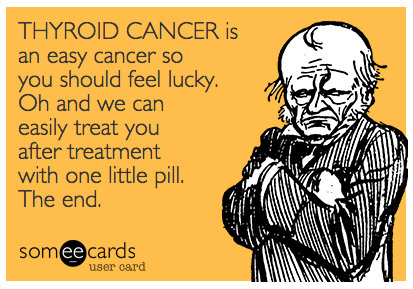
It’s not uncommon when perusing the internet to see the word “easy” associated with “thyroid cancer”, or described as “the best kind of cancer to get”… as if of all cancers, this one is somehow less difficult, less arduous, a walk in the park or a piece of cake cancer.

Nor is it uncommon for thyroid cancer patients to be told something in a similar vein by their doctors. And of course, many of those doctors will use the “one little pill” pronouncement about the treatment afterwards. Easy-peasy, lemon squeezy!!

So where is the truth? Do you have reason to be nervous about your surgery? About your cancer? Is it that easy? What will your life be like after surgery?

One side of the story

Many thyroid cancer patients do report that all went well in many ways. They caught it early enough. It didn’t spread to their lymph nodes. Some didn’t even have to use pain medications after their surgery. If some did, it was short-lived. Others moved over to Tylenol after going home. Or ice packs. Drains were removed smoothly. Recovery went smoothly. Energy returned in several weeks. And they report that the cancer remained gone.

But here’s the other side of the story which completely dispels the myth that thyroid cancer is easy or the “best” cancer to get.

1) No matter where the cancer is, the emotional reaction is the same.

Many a thyroid cancer patient will tell you about their fears, depression, aloneness or anxiety when they were told. Or the denial, anguish, anger and stress they feel. Or the numbness. Or the fears of it returning. Or the unknown.

2) No surgery is fun, and that includes thyroid removal

Who wants to endure the pre-op or the aftereffects of surgery. No matter if some do better than others, it’s not fun to be in a hospital, be put to sleep, the waking up, the drains, the recovery, the discomfort, the time away, and the cost.

3) Many thyroid cancer patients have to endure RAI treatment after surgery and the side effects

RAI stands for Radioactive Iodine Ablation, also called I-131, given in either in liquid or capsule form. Since the thyroid easily absorbs iodine, and the radiation is strong, it serves to destroy any remaining tissue or cells that might still have thyroid cancer in them.

And side effects are far from pleasant and can include isolation, stomach problems, heart palps, neck tenderness, all over achiness, changes in taste, salivary inflammation and parotitis, facial or neck redness or “sunburns”, peeling skin, fatigue, fogginess, nausea, dry eyes, irregular period or other reported problems.

Then comes the reported risks that can come later in life due to having RAI, which include “bladder, breast, central nervous system, colon and rectum, digestive tract, stomach, pancreas, kidney (and renal pelvis), lung, or melanoma of skin”. Keep in mind this is about “risk” rather than a definite outcome, but it’s not fun to consider.

You can read of one patient’s opinion and experience with RAI titled Why have million of patients been treated with RAI?

4) The fear of recurrence always lingers!

Life-long monitoring is a sure bet when one has had thyroid cancer. The itchy reminder that it “could” come back never goes away when one has to have neck examinations, certain thyroid blood tests or neck ultrasounds.

5) The “one little pill” mantra of easiness is foolhardy

That one little pill is a reference to T4-only, aka thyroxine or levothyroxine, also commonly known as Synthroid or other brand names. And reported patient experiences for all too many reveal continual problems, sooner or later. Equally as silly, that one little pill leads to the use of many other pills to treat the symptoms of continued hypothyroidism that many report finding themselves with while on the T4-only, one little pill. Those include statins, anti-depressants, anti-anxiety or pain meds, to name a few.

The conclusion?

You are not alone. Thyroid patients know that thyroid cancer is not as “easy” as they make it sound, nor is it the “better” cancer! We are with you! Join the group below for camaraderie, wisdom and support!

This page was brilliantly updated July, 2015 to reflect even better information. Enjoy!

**************

1-Screen Shot 2015-01-31 at 8.23.50 PM

Check out this photo, about Vitamin D, 64 symptoms removed, and life after thyroid cancer~

OOPS. THIS GAL’S DOCTOR WAS A BIT CLUELESS…

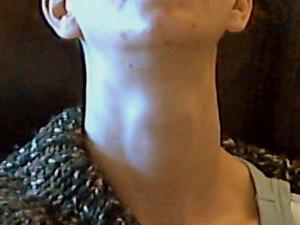
Look carefully at the photo to the left. You will see the actual outline of this woman’s thyroid. It’s obvious. It’s swollen. A swollen thyroid is called a goiter, and can be due to an autoimmune attack of the thyroid called Hashimotos, aka thyroiditis.

Yet, this woman’s doctor insisted she just had a throat infection, gave her penicillin for 12 days, and the outcome?  It’s still inflamed and sore. Jeez, doctor!! WHAT were you thinking!  She states: I always feel something pressing down on my neck and food gets stuck and then I’m having a chocking session. CLEAR thyroiditis and a blind doctor!

Thanks to this gal’s participation in the Stop the Thyroid Madness Facebook groups, she knows the truth, is empowered, and is going to try and get the RIGHT labs and treatment this time! Her biggest challenge is where she lives–the UK with a very dark- ages medical system that worships T4-only and doesn’t get the efficacy of Natural Desiccated Thyroid. It’s not a pretty picture in the United Kingdom or a lot of European countries if you have thyroid disease.

VITAMIN D–DON’T DISMISS THIS IMPORTANT VITAMIN FOR YOUR THYROID HEALTH!

Vitamin D is considered a steroid plus a prohormone, i.e. it’s not yet a hormone, but has affects on real ones. And your body can get it from sunshine exposure, or you can supplement with it. Why is it a great vitamin? It helps balance out your calcium levels and bone density, can help lower stress and blood pressure, and promotes a good immune system.

Vitamin D is found in two forms: cholecalciferol (vitamin D3) which is made via skin exposure to sunlight, or ergocalciferol (vitamin D2). D3 is the natural form and why it’s often preferred for supplementation over D2. After vitamin D3 is formed in your skin or taken as a supplement, it is then metabolized into two different substances: 1) 25-hydroxyvitamin D (25(OH)D), known as calcidiol and your storage Vitamin D, and 2) 1,25-dihydroxyvitamin D (1,25(OH)2D3), known as calcitriol. The former is the Vitamin D you measure via blood.  Good information on both can be found in the abstract here.

So why bring it up?  First, it’s important for your thyroid, i.e. it has to be in sufficient amounts for thyroid hormones to work in your cells. And second, a huge body of thyroid patients find themselves with low levels of this important vitamin! How to raise it? It can take 10,000 IU’s of D3 daily. Some doctors even prescribe more and sometimes once a week in these very high amounts. Add an acid to the drink you use to swallow your Vit. D–like one tablespoon Braggs Apple Cider vinegar, or lemon juice. It will promote better absorption.

SHE ELIMINATED 64 SYMPTOMS THANKS TO NDT AND TREATING HER LOW CORTISOL!! 

Next time you hear that NDT is not good, think twice. Her name is Mary, and you should check out the 64 symptoms she eliminated thanks to NDT, here.  You will see that she’s still working on a few more, but the difference is stunning!

A TESTIMONY FROM A COLLEGE STUDENT OF HOW NDT CHANGED HIS LIFE AFTER THYROID CANCER (even more than being on T4 with T3!)

I’m a male college student and in 2008 I was diagnosed w/ thyroid cancer. Cancer aside, I was placed on Cytomel followed by Synthroid. When I asked my doctors for natural options they said there were no such meds. For four years I was a prisoner in my own body. I had rapid mood swings, I was always cold, had a lack of energy and worst of all dry skin. The dry skin became so bad that I started to develop cystic acne covering my entire back and many on my face–I had no confidence and work out 5x a week yet I was scared to take off my shirt. I knew that there had to be a solution being that I didn’t have any of these symptoms prior to getting my thyroid removed so I began to research. This website, Stop the Thyroid Madness, got me in the right direction as far as understanding the role o f T3 and T4. After many lies, and doctors who denied to write for Armour or Naturethroid, I finally found a woman who knew about the “madness”. I have only been on Naturethroid for one month and my TSH, T3 and T4 levels may be off but I feel like the old me again! I have energy, I have steady moods, I have less brain fog and my skin is finally producing oil again and my acne is almost cleared 100%! Thanks for your work your site had changed my life for the better!

DID YOU KNOW THAT THE STTM BOOK IS AVAILABLE IN ENGLISH, SWEDISH AND GERMAN?? A perfect gift for your friend or loved one who speaks any of those languages. Go here.

UK celebrities with thyroid cancer or disease

clareblading1Thyroid problems have become rampant.

And it’s not just in the US with individuals like Oprah, fitness guru Jillian Michaels, Sex and the City’s Kim Cattrall, George and Barbara Bush, Kelly Osbourne and others. A recent article in the Daily Mail-UK highlights the saga of Clare Balding, the BBC TV sports presenter in the UK whose thyroid was gladly removed due to a malignant tumor.

Even the gal who wrote the well-written article about Clare, Pippa Jolly, reports having gone through the same removal 13 years previous due to an extreme case of Hashimotos and a nodule pressing against her trachea.

But within the informative and hopeful tone of the article are a few Rodney Dangerfield thuds of the continuing SCANDAL and idiocy of a particular thyroid treatment which even the most innocent of article writers can be fooled.

Thud #1: The very first sentence of the article says: Some good news for Clare Balding, the BBC TV sports presenter, is that her recent operation to remove her cancerous thyroid gland – a thyroidectomy – should be the end of the matter.

End of the matter? Only if she had been put on desiccated thyroid like Naturethroid, et al. Because it appears she’s on the delightfully enchanting synthetic “thyroxine“, the darling of most UK doctors and which serves to leave almost everyone with their own brand and intensity of continuing hypothyroid symptoms. You can listen to my audio here about T4.

Thud #2: Diagnostic rates are on the increase, says Professor Monson, as thyroid tests are now done routinely at GP surgeries. ‘As a result there is a higher detection rate and the disease can be tackled earlier and if necessary followed up by surgery.

Right. Those increasing diagnostic rates, some which are based on the lousy TSH lab test, are overridingly catching someone’s hypothyroid state years after it started, which leaves a certain percentage with the misery of adrenal insufficiency and host of other problems from being undiagnosed so long. And if one is treated after surgery based on the same holy TSH, you will only continue to have your brand of continuing symptoms. You can listen to my audio on the TSH here.

Thud #3: If the thyroid is removed or not functioning properly, thyroxine will need to be taken in drug form for life.

You and millions of others have been hoodwinked into thinking it’s thyroxine you will need the rest of your life, aka Eltroxine, Synthroid, or levothyroxine, et al. But those T4 meds force you to depend on conversion alone, a process not well done in many, and you miss out on what natural desiccated thyroid would be giving you as a much wiser treatment–exactly what your own thyroid gives: direct T4, T3, T2, T1 and calcitonin. Or even at the VERY least, giving yourself synthetic T4 with synthetic T3.

Thud #4: Now I have to have my hormone levels checked every three months and make sure I take my medication, but otherwise I feel fine.

I completely believe Pippa when she says she feels fine. But I want to warn her: some CAN feel fine on a T4-only medication, but eventually and especially as she ages, she’s going to have to watch out for those pesky little demons of being on an inferior, inadequate medication, which can include rising cholesterol, chronic low-grade depression, rising high blood pressure, or a host of other symptoms which are individual to each person on thyroxine.

Here’s hoping Clare and Pippa join the growing body of patients all over the world whose lives are being changed thanks to natural desiccated thyroid.

*Want to be informed of these blog posts? Curious what I’m ranting about now? Use the Notifications on the lower left of the links.