Skip to content

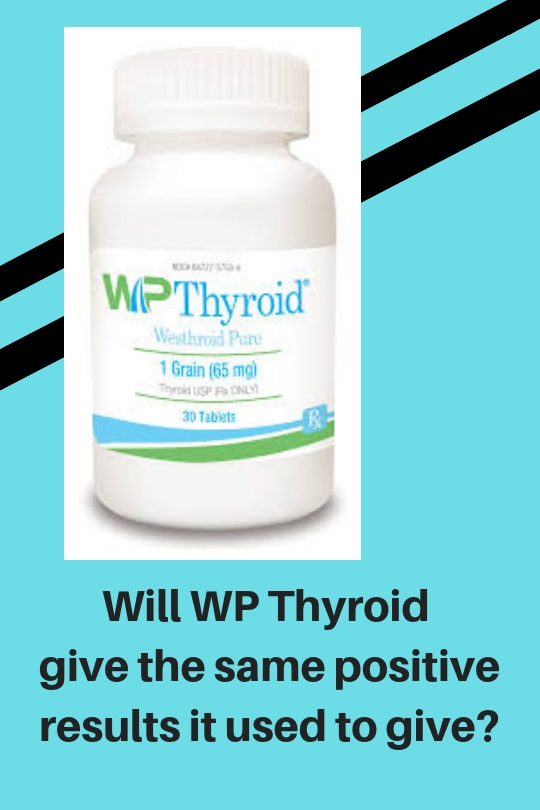
Let’s talk WP Thyroid–not the old one….the NEW one recently coming out!

UPDATE: This page was written in December 2018, and by Summer of 2019, even NP Thyroid was starting to go downhill. Here’s a blog post which explains it all: https://stopthethyroidmadness.com/2019/09/23/the-sad-saga-of-where-we-are-today-as-hypothyroid-patients/

**************************************

RLC Labs, the makers of Naturethroid, WP Thyroid, and what used to be called Westhroid, has been around a LONG time. All are natural desiccated thyroid. meaning they are made from porcine powder and contain all five thyroid hormones, T4, T3, T2, T1 and calcitonin.

And RLC is correct in promoting themselves as the “pioneer and industry leader in the field of hypothyroid treatment.1 They started out in the 1930’s, even though the pharmaceutical name was different for awhile, aka Western Research Labs/Laboratory.

A change started in 2017 with WP

But in 2017, thyroid patients started to see both Naturethroid and WP Thyroid slowly or quickly run out in their pharmacies and on websites, and achieve backorder status. That problem persisted into 2018.

What caused this change? Patients reported that RLC stated it was due to needed machinery updates. But??

Mid-2018

Finally, in 2018, loyal patients excitedly reported the slow return of Naturethroid natural desiccated thyroid to their pharmacies.

But with that return came a growing body of reports from patients in many groups, including the Stop the Thyroid Madness Facebook page, that they were seeing a major return of their hypothyroidism on the “new” Naturethroid…rising TSH, low free T4, low free T3, erratic frees and TSH, fatigue, depression, dry skin or hair, hair loss, anxiety, lowering of iron or B12 or Vitamin D, stiff joints, pain, achiness…on and on.

And now come some reports of an adrenal problem after being on the new Naturethroid

What are adrenal problems? It’s finding oneself with either low cortisol, high cortisol, or mixed highs and lows–any can be the result of the adrenals trying to kick in due to the return of hypothyroidism on Naturethroid. Some proved it by doing a saliva cortisol test,.

Thus, as they have been moving over to NP Thyroid by Acella2, or Armour second, or the two T4/T3 synthetics or T3….they have problems raising any of them, or problems being on the same amount. They then blame the different NDT, T4/T3 or T3-only, which instead is just the latter now revealing the cortisol and/or iron problem!!

But I feel good on the new Naturethroid!

Yes, there have been what looks like a minority who state they feel “good” on the “new” Naturethroid. But what we noticed over time is that a certain body of those came back and said they started to feel the problems creeping up on them. Here’s the string to talk about your experiences with the “new” Naturethroid:

https://stopthethyroidmadness.com/2018/05/16/naturethroid-wp-thyroid-rlc-labs/

What about WP Thyroid?

The end of 2018, especially December and when I am first writing about this, is where reports started trickling in that WP Thyroid was making a comeback in certain pharmacies. Questions about it have surfaced, such as “Is it going to be lousy like Naturethroid has been for so many of us?”, “Can we trust RLC?” and “Do I dare try it when I’m now doing well on NP Thyroid or Armour?”

One person reported directly to me that the bottle looks the same, the label looks the same, the ingredients look the same.

What we want from you!!

This will be YOUR STTM blog post to comment on your experiences with the “new” WP Thyroid…now and the longer you stay on. Let us know if you note any differences in the pills, in the smell, in the results. Let’s share patient-to-patient and learn from each other…which is STTM’s purpose!!

Note: by using the word “new” in front of Naturethroid or WP, it is just a reference to coming out again in 2018.

Footnotes:

1. https://www.rlclabs.com/about.php

2. https://npthyroid.com/

All about Drug Recalls and what happened to Westminster’s Natural Desiccated Thyroid

Probably most people have heard about “drug recalls”, but may not know the ins and outs about recalls.

What is a recall?

I personally think the best definition of a drug recall comes from the Saunders Comprehensive Veterinary Dictionary1: a voluntary action of removing a product from retail or distribution by a manufacturer or distributor to protect the public from products that may cause health problems.”

Note the word “may” cause. Recalls can also be about risk, not just about definite adverse consequences.

So a recall is voluntary by a pharmaceutical?

It definitely can be. And it can also be at the request of the FDA. Either. From the FDA2: Drug recalls may be conducted on a company’s own initiative or by FDA request. FDA’s role in a recall is to oversee a company’s strategy, assess the adequacy of the recall and classify the recall.

What are reasons for a recall?

WebMD3 defines five potential reasons:

1) it’s a hazard to your health
2) it’s mislabeled or poorly packaged
3) it’s potentially contaminated during production or distribution
4) it’s not what it says it is
5) It’s poorly made, effecting it’s quality, purity, and/or potency

For #3 above, note that the potential contamination may be harmful OR non-harmful.

Are recalls common?

Believe it or not, yes! A 2017 article in the Journal of the American Medical Association4 stated that 1/3 of all prescription meds have been recalled due to “safety events”.

If something I take has a recall, what do I do? Can I get my money back?

Yes. But you do need to call the pharmacy from which you got it, first. They have to get official notification of the recall before giving that refund.

Shouldn’t I get a replacement for my prescription medication before taking it back?

Call your doctor so he or she can prescribe a different one before you return your recalled medication. That way, you can pick it up at the same time you return your recalled medication, say experts.

*************************

Now let’s move to a recent recall of one particular natural desiccated thyroid medication by Westminster Pharmaceuticals.

Westminster came out with its own natural desiccated thyroid (NDT) product, considered a generic version, in late 2017. You can read more about their NDT product on Stop the Thyroid Madness’s page which lists brands and ingredients, here.

Westminster voluntarily issued a recall of their NDT in August 2018 due to “risk of adulteration”. See below.

Why did Westminster voluntarily issue a recall?

The recall states it was done “as a precaution because they were manufactured using active pharmaceutical ingredients that were sourced prior to the FDA’s Import Alert of Sichuan Friendly Pharmaceutical Co., Ltd., which as a result of a 2017 inspection were found to have deficiencies with Current Good Manufacturing Practices (cGMP). Substandard cGMP practices could represent the possibility of risk being introduced into the manufacturing process.”

It’s important to point out the words “possibility of risk”. That is different than a definite negative outcome as having occurred. But time will tell.

And if you really want to get into detail about why the FDA issued an alert about Sishuan Friendly Pharmaceutical, the maker of desiccated thyroid powder that Westminster was using, it’s all here.

How do I know if my particular bottle of Westminster’s NDT is part of this recall?

The recall notice lists many lots. You’ll need to call your pharmacist to see which lot your bottle came from. But it does appear that most of Westminster’s NDT has been recalled by the long list of lot numbers.

Has anyone been harmed by their use of Westminster’s NDT?

In the 2009 recall wording, it was stated “To date, Westminster Pharmaceuticals has not received any reports of adverse events related to this product.”

Is this the first time that any thyroid medication has been recalled?

Nope. For example, Levoxyl, a T4-only medication, was recalled in April 2013. Synthroid, another T4-only medication, has been recalled numerous times due to issues like subpotency and the same failure to follow good manufacturing practices.

Is 2018 a year of Natural Desiccated Thyroid mishaps??

Boy oh boy, it sure has been.

First, RLC’s Naturethroid and WP Thyroid ceased production in 2017, and Naturethroid only started creeping back in 2018. But sadly in 2018, there seem to be quite a few patients reporting it to be far weaker than it used to be and finding that out the hard way with the return of major hypothyroid symptoms. Some are trying to raise it to see if they can regain their former feel-goods; others have been switching to other brands.

Then comes this with Westminster’s NDT. What a mess.

Is there a conspiracy at foot to take our NDT away?

No, it does not appear to be conspiracy.

My doctor claims these recent issues prove that desiccated thyroid is unreliable and I should use Synthroid. What do I say?

You say “What is proven by millions over the years is that T4-only like Synthroid is the unreliable way to treat hypothyroidism”.

So where do I turn now?

People have been moving over to NP Thyroid by Acella, or Armour. You can also choose to have your NDT compounded. Or move to synthetic T3 with synthetic T4. But the goals are the same, which for years includes seeking a free T3 towards the top part of the range, and a free T4 midrange. Both. And to achieve the latter, it’s still important to have the right amount of cortisol and iron, we’ve learned repeatedly, because if you don’t, you can see problems. Too often, people blame their problems on NDT, when in reality, it’s what NDT or T3 reveals that is the problem.


Footnotes:

1. Saunders Comprehensive Veterinary Dictionary, 3 ed. © 2007 Elsevier, Inc.

2. https://www.fda.gov/Drugs/DrugSafety/DrugRecalls/ucm612550.htm

3. https://www.webmd.com/a-to-z-guides/what-is-a-drug-recall#1

4. http://jamanetwork.com/journals/jama/fullarticle/2625319

Feel better on T4 than you did on Natural Desiccated Thyroid?

Occasionally, hypothyroid patients will exclaim with conviction and truth that they outright feel better on Synthroid or Levothyroxine (T4-only meds) than they did when they tried Natural Desiccated Thyroid (NDT) or even T3-only.  And we believe them.

But…there is an explainable reason which does not mean T4-only is better for you. It really isn’t. Bear with me and read on…

Years ago, as many of us were starting on NDT after being on T4, we were seeing our lives change in a huge way, far more than T4 did! It was like a miracle! Those five hormones really made a difference.

But some others were having problems when raising something so miraculous for others. Huh?? We didn’t get that.

It took awhile longer to finally see why and to answer the “huh?” i.e. we began to see that there were three strong and correctible reasons why someone was not seeing the miracle of NDT as others were, and instead, were blaming the NDT (or T3) and moving back to T4-only…

The three main and correctible reasons why NDT, which gives all five thyroid hormones, seems to fail…

1) NOT BEING “OPTIMAL” WITH YOUR NDT DOSE (it’s NOT about just being in range and not about being held hostage to the TSH)

We all have had a tendency to believe that our doctors know what they are doing with NDT or T3. But, the majority do not. They tend to leave you on too-low doses, and/or pay attention to the lousy TSH. Thus, due to the natural suppression of the feedback loop (hypothalamus to pituitary to thyroid), you will get worse on those lower doses, sooner or later. i.e. you will get more hypo, and/or have rising adrenaline, cortisol, anxiety or other. And because of that, some exclaim “NDT didn’t work for me!” and they rush back to T4-only.  But NDT, with all five thyroid hormones, could have worked well IF you had known to be more optimal. Optimal puts the free T3 towards the top of the range and the free T4 mid-range, and puts the TSH below range…all three…and removes all symptoms. What amount does that is very individual—some start to achieve that in mid-2 grains, others are in the 3-5 grain area, others may be higher.

What if you tried to raise to be optimal, but had worsening problems? Read #2 and #3 below.

2) NOT BEING OPTIMAL WITH YOUR IRON LEVELS (it’s not about just being in range)

When this is brought up to patients who once tried NDT and failed, they will exclaim with all sincerity “But my iron levels were great”. We know that a very small percentage may have had good iron. But what is common with the majority is they did NOT have good levels “Falling in the normal range” does not equal a good level of iron. It’s WHERE one falls that tells the story.

For example, with two types of ranges for serum iron (NOT ferritin):

a) When the range is approx. 40?155: women who have optimal serum iron tend to be close to 110, or 109, or 108, etc. They are NOT in the 90’s and definitely not lower when optimal. Men tend to be in the upper 130’s.
b)  When the range is approx. 7-27: women are optimal around 23ish; men are towards the top.

If they are lower than the latter examples, it messes up the ability to raise NDT and feel great without issue. Why? Inadequate iron levels tend to raise the reverse T3 (RT3) as one is raising their NDT.  As the RT3 goes up due to inadequate iron, you will feel worse. And because of that, some exclaim “NDT didn’t work for me!” and they rush back to T4-only…but if they had had optimal iron, NDT WOULD have worked…as long as they also had optimal cortisol (See #3 below) and were working to find their optimal dose of NDT (see #1)

See more details about iron here: https://stopthethyroidmadness.com/ferritin

3) NOT BEING OPTIMAL WITH YOUR CORTISOL LEVELS (it’s not about just being in range, and it’s NOT about blood cortisol)

We noted years ago that at least 50% of those with hypothyroidism had a cortisol issue as revealed by saliva, not blood. What does a cortisol issue mean? Either their cortisol was too high (due to the stress of being undiagnosed, poorly treated, or being on T4) or was too low (due to the stress of being undiagnosed, poorly treated, or being on T4), or had both high and low (due to the stress of being undiagnosed, poorly treated, or being on T4).

And what happens with a cortisol issue when you are trying to work with NDT? Either RT3 will go too high (the inactive hormone), or one’s T3 will pool in the blood and not make it to the cells, or both…and you won’t feel well or have bad reactions like excess adrenaline, anxiety, shakiness, feel-bads.

And because of having a cortisol issue, some exclaim “NDT didn’t work for me!” and they rush back to T4-only…but if they had…

a) done the 4-point saliva test, not blood
b) compared the saliva results it to the lab-values page (it’s not about that normal range)
c) CORRECTLY treated it (see this page, plus Chapter 6 in the updated revision STTM book if saliva is VERY low, which also applies to Adrenal Cortex),

….they would have soared on NDT…along with good iron and being OPTIMAL on NDT (or T3)

Note: it’s always about the results of a saliva test, NOT blood cortisol.

Bottom line, it’s not as simple as “feeling better on T4”. It’s more about that you are NOT experiencing the side effects that you did on NDT from any of the above three problems, which were all correctible. That is different.

“That all sounds like too much trouble–I’m staying on T4-only!”, you may be exclaiming….

There is a big problem with that reasoning that I hope you will be open to….Namely, T4-only outright…

  • CAUSES low iron
  • CAUSES a cortisol problem
  • CAUSES many other issues like lowered B12, lowered Vitamin D, rising blood pressure, rising cholesterol, depression, anxiety, heart issues, bone thinning, chronic pain….and more. The individuality is in who gets which…but T4 users do get problems of their own kind, sooner or later.

Please note that the above is not an empty strong opinion. It’s based on years of reported patient experiences from many who were on T4! i.e. most of the following hypothyroid symptoms were experienced by T4 users!! They were still hypo!

Now you may state “But I know people on T4 who do not have those problems!”.

First, some outright DO have some of those problems, but don’t realize it or they deny it (while others see it in them). Adrenal issues, even those denied, can make certain people awash with defensiveness, argumentativeness, denial, anger, paranoia towards others observations, low patience, moodiness, etc.

Yes, some on T4 do, in fact, do better than others. But you know what we have observed? The longer they stay on T4-only, the more problems WILL, in fact, raise their ugly heads eventually…like either adrenal issues, or low iron, or low B12, or depression, or rising cholesterol, or rising blood pressure, or heart problems, or dry skin and hair, or chronic pain, or bone loss, or rising illnesses…..on and on. Forcing the body to live for conversion alone backfires….sooner or later.

Summary: A working Natural Desiccated Thyroid, or adding T3 to that T4 as a second choice and getting those frees optimal, is a much better way to go than being on nothing but T4, according to years of worldwide patient experiences

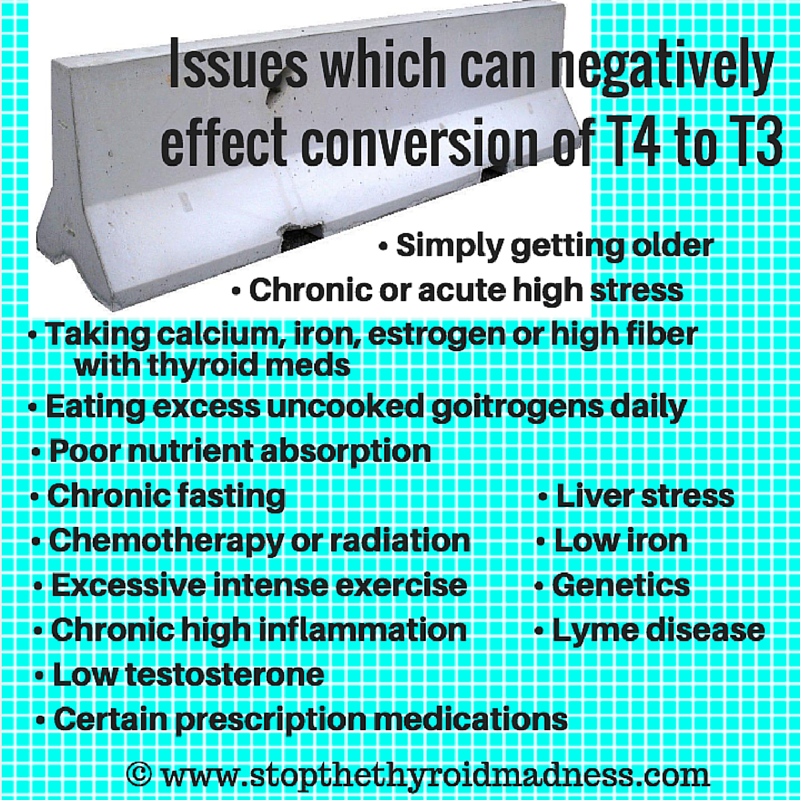
A working NDT gives you all five thyroid hormones, and does NOT force you to live for conversion of T4 to T3 alone, i.e. some of NDT is direct T3. Additionally with T4-only, some people have genetic mutations which hinder the conversion of T4 to T3 and may not realize it.

There is a good reason that millions of patients found out that T4-only is not the way to go for many reasons, and NDT is the way to go if you correct the reasons you did NOT to do well...or even adding T3 to your T4 in an OPTIMAL amount. But you will still need optimal iron and cortisol!

P.S. The above three reasons are the most common for not doing well on NDT (or T3) and should be considered first. A 4th less common reason: chronic inflammation of any cause. Read about inflammation. If this is true for you, the sad part is that T4-only will also backfire, as it raises RT3.

Mold exposure can also effect conversion.

Click on the graphic to order an excellent saliva cortisol test.