Skip to content

Thyroid Tidbit: Oprah was on Methimazole, a thyroid blocker

Screen Shot 2015-08-10 at 11.08.31 AM

(This page was updated in 2015. Enjoy!)

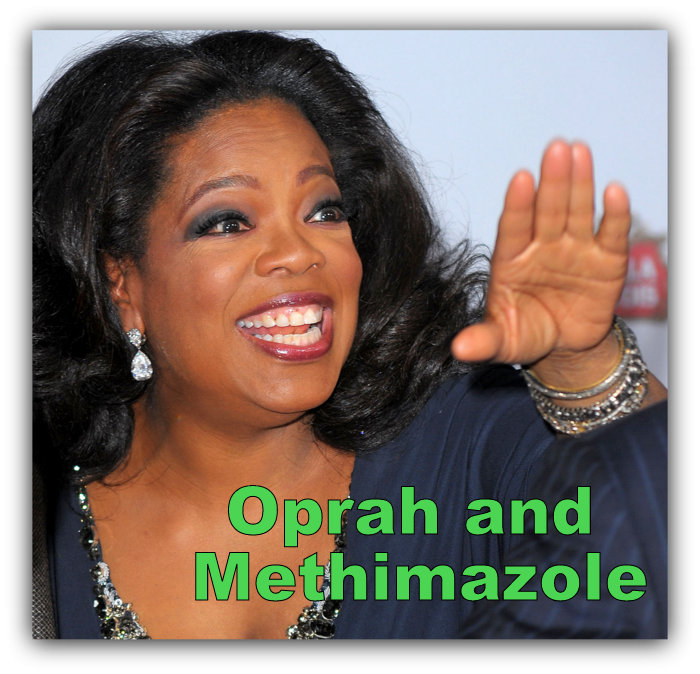
Oprah admitted in January, 2009, on her Best Life Webcase, that she was on Methimazole (Tapazole) when treating her thyroid problem.

Methimazole is an anti-thyroid drug, often used to treat hyperthyroidism, aka Graves disease, or a toxic multinodular goiter. It’s known to inhibit the enzyme thyroperoxidase. In healthy thyroid functioning, this enzyme is made in your thyroid and is an important component in the production of thyroid hormones. But with hyperactivity of the thyroid, it can become a problem.

Oprah may have needed the treatment for Hashimoto’s Toxicosis–an autoimmune combination of Hashimotos and Graves. Treatment with Tapazole can be common in treating Hashimoto’s Toxicosis. Because of that treatment, she may have then fallen into hypothyroidism, since there was mention of a 20 lb weight gain, exhaustion and depression—common symptoms of hypothyroidism.

We don’t know much else, but it’s too bad this issue by such a well known celebrity didn’t move her into more discussion about better thyroid treatment with Natural Desiccated Thyroid or T3 in one’s treatment, especially when so many lives have suffered due to the medical practitioner love-affair with Synthroid and other T4-only medications. Many of us were highly disappointed.

Anybody had Hashi’s Toxicosis and treated with Tapazole? What’s your experience with Methimazole (Tapazole)?

JanieSignature SEIZE THE WISDOM

* Want to receive notification of each blog post that comes up here? Sign up below.

* Come on over to the STTM Facebook page for tips and inspiration!

Oprah is spelled D*e*n*i*a*l; the hamster wheel of her life

(Want to receive notification of each blog post that comes up here? Just go to the Notification on the left of this page below the links and sign in with Notifixious).

Well, here we go again.

As this first week of Oprah’s “Best Life Week” series ends, we all know that Oprah has announced she is going on a weight loss and exercise plan once again (hamster wheel turning, turning…). Oh…and did I mention that she said her hypothyroid was cured?

(Wait. Do I hear a collective and worldwide SIGHHHHHHH among thyroid patients??)

Thyroid patient Mary Shomon now shares my own long-held concerns in an excellent summary pertaining to Oprah’s thyroid and weight saga. Oprah has been remarkably uninformative about her diagnosis and details, and leads those uninformed to believe they can stop taking their medication and be cured. And Oprah appears to have ignored a slew of emails over the years from all camps of thyroid advocacy!

Just as bad is a visit in the pages of O Magazine. On page 151 of the January issue, and right next to the article about Oprah’s weight gain, is a side article titled The Truth About the Thyroid. And the longest paragraph is about the use of the TSH lab test and its so-called normal range–one of the worst tests ever created to diagnose and treat hypothyroidism. Additionally, the article ends with the mention of a prescription of synthetic thyroxine–a medication which leaves nearly everyone with lingering hypothyroid symptoms.

But the disappointment in Oprah has to go farther than a general call to be educated about thyroid disease. There is a need to be specifically educated about the scandal of thyroxine treatment, about the fallacy of the TSH lab test which leaves patients undiagnosed for years or undertreated when on meds, about the rampant problem with adrenal fatigue in thyroid patients on thyroxine or those left undiagnosed (and where Oprah may be headed), and about a far better treatment with desiccated thyroid like Armour, and optimizing other areas, including ferritin, B12, and our overall health.

Let’s not give up.

Success is like lottery tickets: you have to make several attempts before that magic one makes it. Eventually, your email can be the one that finally stops her hamster wheel of “eat less, be hungry, exercise more, it’s not my thyroid” mentality. Tell Oprah about your success, others success, the patient-to-patient site www.stopthethyroidmadness, and more. And don’t hesitate to share your email below.

I am pleased to announce labs designed by Stop the Thyroid Madness

An intriguing thought: what if there were lab packages specifically designed by Stop the Thyroid Madness and all its patient-to-patient wisdom. Well, there are!

STTM has created lab profiles in partnership with MyMedLab, a direct-to-consumer lab facility which has expanded to provide services to nearly the entire United States

This lab facility promotes the empowerment of patients in their own care, similar to STTM’s focus on educating the patient and expecting a partnership when you walk into the doctor’s office. Empowerment!

You will find a combination of both in-home collected tests (saliva cortisol) and those performed at LabCorp collection sites across the US. Take a Peak: STTM Lab packages (be sure and click on the green What’s Included icon on the lower right. You get a lot!)

Fifteen Most Annoying Phrases ever to come out of a doctor’s mouth

In honor of 2009, a year we hope to see bold changes in the medical system, Stop the Thyroid Madness presents the Fifteen Most Annoying Phrases From the Mouths of Doctors. (Note that the word “Armour” has been used for simplicity sake; any prescription-grade desiccated thyroid product can be inserted there.)

Here’s raising our New Year’s stemmed glasses to change!

15) I’ll see you in eight weeks.
14) Here’s a script for [insert any non-thyroid medication to bandaid continuing hypo symptom]
13) The free T3 lab test is not necessary.
12) Your symptoms do not warrant a thyroid medication.
11) You’re tired because you are [insert any label like “a mother” “menopausal”, etc]
10) That has nothing to do with your thyroid.
9) I can find nothing wrong with you.
8 ) You need to eat less and exercise more.
7) Your TSH is too low.
6) The TSH test is [insert any positive description, like “a reliable marker” or “sensitive measure”]
5) I do not believe in Armour.
4) Armour is [insert any negative adjective/description like “unstable” or “hard to regulate”]
3) You’re depressed.
2) You are hyper.

….and tah-dah, the #1 most annoying phrase that comes out of the mouth of a doctor:

1) You are normal.

Doctors still have a long way to go a.k.a. Those symptoms might just be the thyroid!

Just as I was finishing up the post below about a short summary on the Endocrinology Today website, I saw a link at the bottom of the page that interested me. It took me to a blog post on the same site from December 10th titled “Why can’t it be my thyroid?”.

And a slew of thyroid patients around the world, as well as a growing body of doctors, would completely disagree with this post.

Namely, a DO explains the problem of patients arriving in doctors offices with “innumerable possible symptoms of hypothyroidism” including “fatigue, cold intolerance, decreased energy, weight gain, depression, hair loss, low libido, menstrual irregularity and others.”

Yet, he bemoans, these patients have a “normal TSH” which is “well within the normal laboratory reference range.” He also refers to their normal free T3 and free T4, and states there is no history to suggest pituitary dysfunction or that the TSH is unreliable.”

He then proceeds to pat himself on the back because he 1) will treat some patients with a high-normal TSH and other clinical features, 2) he will treat to a low-normal TSH of less than 2.0, but like the good-boy-doctor, “still within the normal laboratory reference range” and 3) he will not induce iatrogenic hyperthyroidism, even if symptoms persist. (yikes)

“Iatrogenic hyperthyroidism”?? Since “iatrogenesis” refers to harmful medical procedures, he’s probably referring to a TSH below the range, which in his mind, equates to hyperthyroidism.

***Then comes the observation that has made many thyroid patients shiver, since so many doctors have said it: because he feels that adding T3 to T4 has more negative results than positive, he explains to his patients that there may be causes of their symptoms besides the thyroid.”

THUD.

So here is my 6-point response to any doctor who might share these beliefs:

1) There’s hardly a thyroid patient around who hasn’t had a so-called “normal” TSH in spite of clear and obvious hypothyroidism. The TSH lab test frequently lags behind what is reality in the body, and has been doing so since it’s creation in the early 1970’s (see Chapter 4 in the Stop the Thyroid Madness book for history).

2) Having a “normal” free T3 and free T4 means nothing. It’s “where” the result falls in that range that means something. i.e. patients all around the world are noticing that having a free T3 mid-range or lower in the presence of hypothyroid symptoms is usually a BINGO lab result pointing to hypothyroidism.

3) Exactly because doctors tend to dismiss clear hypothyroid symptoms as “something else” thanks to a lousy TSH reference range, a burgeoning number of thyroid patients are falling into adrenal fatigue with its low cortisol, which serves to mess them up even more.

4) A huge body of thyroid patients who are on desiccated thyroid hormones (aka Armour, Naturethroid, etc), and who finally have a complete removal of symptoms with a normal temperature and heartrate, also have a suppressed TSH lab result, and not one iota of “iatrogenic hyperthyroidism.”

5) When it appears that adding T3 to T4 is having negative effects, the problem is most likely adrenal fatigue that needs correction, and/or low ferritin, NOT deciding that the symptoms must be from another cause or T3 doesn’t work.

6) “Fatigue, cold intolerance, decreased energy, weight gain, depression, hair loss, low libido, menstrual irregularity and others” may be shared in other conditions, but you are most likely missing CLEAR symptoms of hypothyroidism, both in the undiagnosed patient with a so-called normal TSH, or with a patient treated with the lousy thyroxine, which leaves most everyone with continuing hypothyroid symptoms.

“I’m sorry. It IS your thyroid” is exactly what patients need to hear.